
From My Bookshelf
Theda Skocpol, Protecting Mothers and Soldiers: The Political Origins of Social Policy in the United States (1992)

When I was finishing graduate school in 1996, the field of political history had already been unpopular for some time. Over the previous decades, historians had shifted their attention toward social and cultural history. To better understand the evolution of American politics, many scholars from the Baby Boom era— who I have been exploring in my ongoing series Their Generation—focused on the struggle for power from the bottom up.
For my generation, which came of professional age in the 1990s, a group of historically oriented social scientists helped point the way as we searched for new ways to write political history. Our goal was to avoid repeating the “Great Man” theory of history and instead place institutions and public policy at the center of analysis.
Few scholars were as influential on our work as Harvard University’s Theda Skocpol, one of the pioneering figures in the field known as “American Political Development,” whose practitioners offered an alternative to the rational-choice model of politics by examining how political institutions changed over time. They explored how politics was impacted by critical junctures in history and by path dependency—where earlier decisions, pre-existing commitments, and established rules constrained and directed American politics in current times.
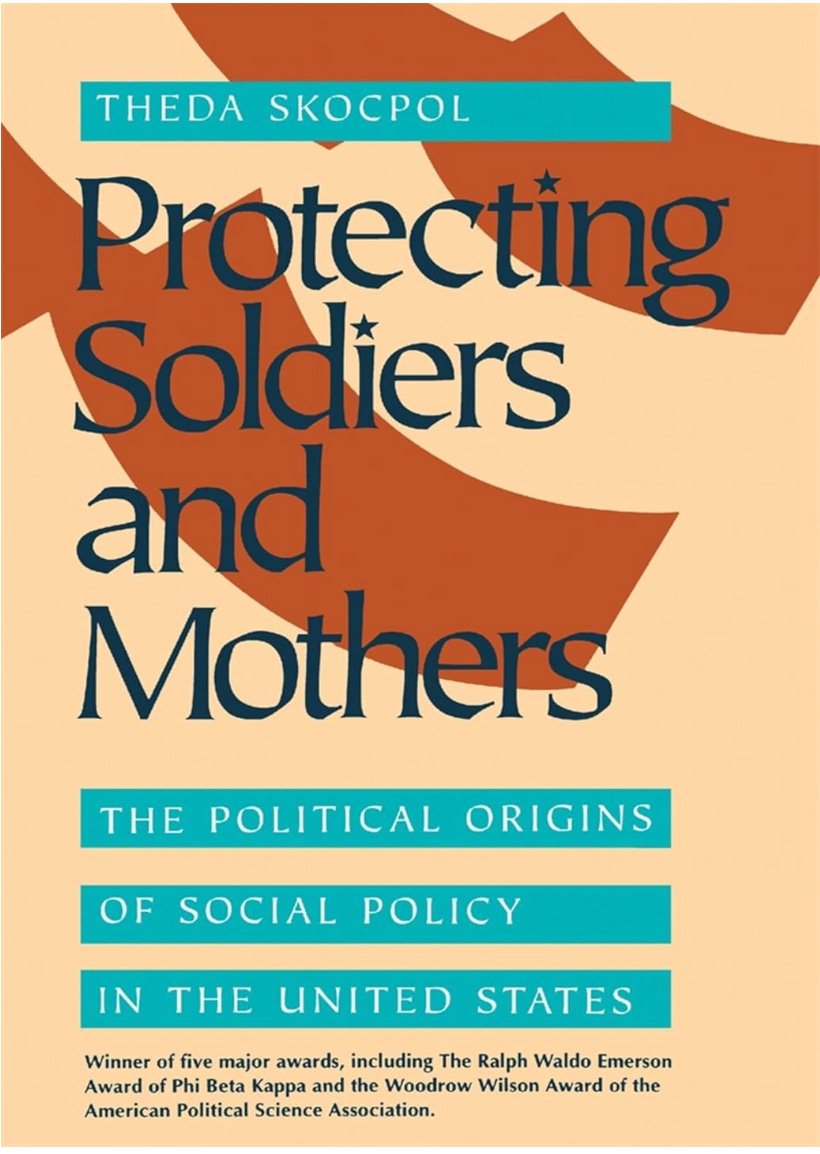
One of Skocpol’s most important books, Protecting Soldiers and Mothers, became a model for historians. The book challenged the conventional argument that before the New Deal and Great Society, the United States lacked a social safety net comparable to those in European nations. Instead, Skocpol argued that the country did develop a substantial system of social provision, one that reflected the political structures shaping American democracy.
First, Skocpol examined the history of pensions for Civil War veterans. These benefits, which provided government support for almost 30 percent of elderly and disabled Americans, were significant. Beyond the fact that veterans were viewed more sympathetically than industrial workers or the poor, the program expanded because of the two-party system: Republicans and Democrats competed against each other to promise more generous support. Ultimately, that same partisan competition undermined the program by opening it up to charges that Republicans were providing benefits to many people as a political reward rather than an earned benefit. This had a developmental effect in that future policymakers had to contend with the perception that pensions for elderly workers could become corrupted by party politics.
