
Their Generation
Linda K. Kerber

At a time when politicians are openly attacking the study of history, “Their Generation” goes back to the scholars who fundamentally transformed the field after the 1960s and, in doing so, changed how Americans understand themselves. These historians shattered narrow canons, introduced ignored voices to the center of the story, and confronted myths of a national history devoid of conflict and struggle. This ongoing series, available exclusively to paid subscribers of The Long View in my Friday newsletter, lets them speak for themselves, at a moment when historical truth is once again under threat.
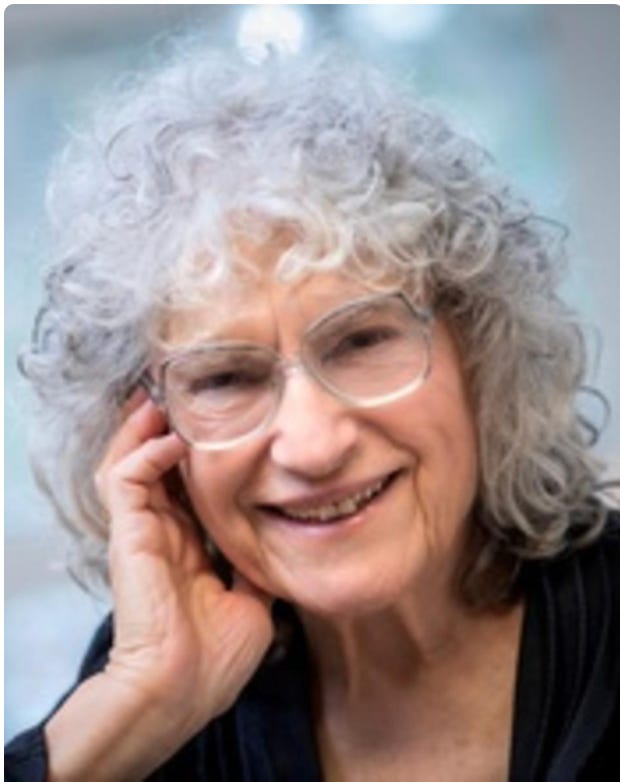
Linda K. Kerber is May Brodbeck Professor in Liberal Arts, Professor of History and Lecturer in Law Emerita at the University of Iowa. In her writing and teaching she has emphasized the history of citizenship, gender, and authority. She is the author of No Constitutional Right to Be Ladies: Women and the Obligations of Citizenship (1998) for which she was awarded the Littleton-Griswold Prize for the best book in U.S. legal history and the Joan Kelley Prize for the best book in women’s history (both awarded by the American Historical Association). Among her other books are Toward an Intellectual History of Women (1997), Women of the Republic: Intellect and Ideology in Revolutionary America (1980), and Federalists in Dissent: Imagery and Ideology in Jeffersonian America (1970). She is co-editor of U.S. History as Women’s History, and of the widely used anthology, Women’s America: Refocusing the Past (9th edition, 2021), which has been translated into Japanese. She is now at work on a book tentatively entitled Legal Ghosts: Stateless in a Nation of Citizens. In 2006 she served as president of the American Historical Association. During the academic year 2006-07 she was Harmsworth Professor of American History at Oxford University. She is an elected member of the American Philosophical Society and the American Academy of Arts and Sciences. Her papers are in the collections of the Schlesinger Library at the Radcliffe Institute.
For more on Linda Kerber’s work, see https://history.uiowa.edu/people/linda-kerber
My interview with Linda K. Kerber:
1.How did your activism in the 1960s and 1970s shape your understanding of how to study and interpret American history?
I grew up in a Jewish family shaped by the Depression, World War II and FDR, which was suffused by a generalized faith in the government. (They had not yet known how many relatives who had not made it into the United States because of the 1924 quotas died in the Holocaust.) When my husband was drawn into Vietnam (there was a doctors’ draft) in 1966-68 my naïve faith was undermined. He was in Vietnam during the Tet Offensive; I learned only much later that he’d come close to falling out of a helicopter on a rescue mission for which he’d volunteered. He came home with a Bronze Star which he never talked about; we are lucky his name is not on the memorial wall in Washington. The Women’s Movement shifted my focus to all we had not explored in the American past.
2.Who were one or two of the key intellectual influences on your work?
--Barnard College: “We are not wasting our time with you, young ladies. Go out and make the world better”. At Barnard we leaned the craft of history. I loved the arcane language of the footnote. In 1957 a formal letter of introduction opened the door to the New-York Historical Society and its eighteenth-century manuscripts.
And a few lines from Brother to Dragons, a book length poem by Robert Penn Warren that we read in a history class:
All night long History drips in the dark
And if you step where no light is
The floor will be slick to your foot.
--Richard Hofstadter, for asking large questions; Gerda Lerner for unapologetically focusing on women’s history, and John Kouwenhoven, my freshman English teacher and pioneer in American Studies, for demonstrating that literature, technology and art can be essential to historical understanding. And Richard B Morris, for a single dazzling course in US Constitutional History, who made it clear that law and resistance to law percolate behind many social movements.
3.Which scholars from your own generation, those who came out of graduate school and advanced through the profession alongside you, have you been most in conversation with throughout your career?
Alice Kessler-Harris, Jane De Hart, Pat Cain (for legal history), Barbara Sicherman, and, although she is somewhat younger, Barbara Welke.
Because I attended a women’s college (Barnard College) and one of my first teaching jobs was also in a women’s college (Stern College of Yeshiva University) even though the curricula there did not focus on women’s history I was ready for feminist questions. And women were hungry for their history: the students demanded it, non-academic women demanded it.
4. Was there a particular turning point in your career that stands out as especially pivotal?
The move to Iowa City in 1971. It was not surprising for two New Yorkers to move to California when Dick returned from Vietnam. It was surprising – to most family and friends – for us to move to the Midwest. But Iowa City is a university town, filled with transplants from elsewhere, and to people whose image of the United States had been Saul Steinberg’s cartoon map, it was invigorating. Our students asked questions not asked in New York or California. I came to understand that the Northeast is only one of many provincial regions in the U.S.
