
Their Generation
Alice Kessler-Harris

At a time when politicians are openly attacking the study of history, “Their Generation” goes back to the scholars who fundamentally transformed the field after the 1960s and, in doing so, changed how Americans understand themselves. These historians shattered narrow canons, introduced ignored voices to the center of the story, and confronted myths of a national history devoid of conflict and struggle. This ongoing series, available exclusively to paid subscribers of The Long View in my Friday newsletter, lets them speak for themselves, at a moment when historical truth is once again under threat.
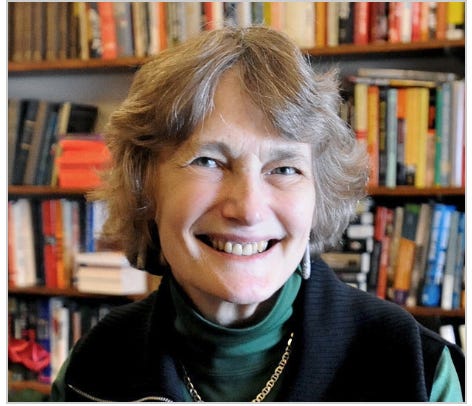
For more on Alice Kessler-Harris’s work, see https://professorsemeritus.columbia.edu/people/alice-kessler-harris
My Interview with Alice Kessler-Harris
1.How did your activism in the 1960s and 1970s shape your understanding of how to study and interpret American history?
Opposing the war in Vietnam, participating in the Civil Rights Movement, and playing a part in the Women’s movement together provided some key insights into prevailing practices among historians. They revealed the limits of archival research—so much of what we wanted to know was not available in traditional archives; They raised questions about the relative nature of “truth,” and they opened the door to exploring the assumption that historical research and interpretation would lend itself to objectivity. My activism, like that of many of my peers, provoked skepticism about empiricism—the idea that simply finding the facts could lead to truth.
2.Who were one or two of the key intellectual influences on your work?
I can’t limit my answer to one or two. I was profoundly influenced by the turmoil in the history of ideas that emerged in the 1960s, and in particular the ideas generated by such British historians as Eric Hobsbawm, E.P. Thompson, and E.H. Carr. Their American interpreters, Herbert Gutman and David Montgomery shaped my approaches to labor history. A little later, Sheila Rowbotham, Barbara Taylor, Leonore Davidoff, Anna Davin, and Catherine Hall among others persuaded me to weigh the interactions of gender, class, and race. But I think if I were forced to single out one influence, I would point to Joan Kelly, a historian of the Renaissance who first suggested the central importance of examining “the social relation of the sexes.”
3.Which scholars from your own generation, those who came out of graduate school and advanced through the profession alongside you, have you been most in conversation with throughout your career?
Ronald Grele, an architect of the Oral history field, has been one of my most engaging contacts in the field of history. Russian historian Barbara Engel, continues to challenge my assumptions about the meaning of family. And the questions that David Thelen asks keep me honest—they push me into never forgetting the purpose of what we do: How does my work, he keeps asking me, help to sustain democracy? But my generation of women historians may have been the most immediately powerful forces in my thinking: Linda Kerber, Blanche Wiesen Cook; Carroll Smith-Rosenberg, Rachel Brownstein, are among those with whom almost daily interactions keep my mind from stultifying.
4. Was there a particular turning point in your career that stands out as especially pivotal?
Coming out of graduate school in the late 1960s, I was introduced to the Berkshire Conference of Women Historians by Margaret Judson, British constitutional historian. The group was then a small organization consisting largely of female historians who had been marginalized by the profession. They were not at all interested in women’s history. But a cohort of newly minted female historians joined around the same time I did. Inspired by the women’s movement, we engaged in an exhilarating discussion of how to support research into the history of women. Out of those debates came the proposal of Lois Banner and Mary Hartman (then both teaching at Douglass College of Rutgers University, to sponsor what became the first Berkshire Conference in Women’s History. Discussions in and around the Berks inspired me to find out more about the women labor leaders I’d neglected in my dissertation. My turn to women’s history inspired new intellectual companions, new questions, and new forms of activism. I became engaged first in The Coordinating Committee of Women in the History Profession ( CCWHP); and then in trying to modify the resistance of the professional organizations (including the American Studies Association, the Organization of American Historians and the American Historical Association) to women historians and to women’s history.
5.You were one of the historians who devoted a great deal of attention to the intersection between labor history and women’s history? How did you think about the kinds of narratives that had been missing and what you wanted to achieve?
When I entered the profession, the newly burgeoning attention to women focused on questions related to domesticity and reproduction. Work was still defined as generally male; the big questions around it focused on the capacity of the male wage to support a family. Even the new family and community studies focused on family as a male-headed and male-dependent unit. Most labor historians insisted that labor history and women’s history were two different fields. The women workers I was tracing didn’t fit—they were simply marginalized as a secondary labor force with little or no staying power, capacity to organize, or wage-earning capacity. They belonged in the home. How, then, could I make sense of these women? What was missing, of course, was that in addition to being wage earners, they belonged to a gendered culture. And that, in turn was imbricated by their racial, class, ethnic, and religious ideals. We’ve since learned of course that males were as much influenced by non-material ideas like Masculinity, Religion, and race as women, but at the time, understanding the labor force as the complex amalgam of motivation and desire that it is, underlay my effort to understand labor and women’s history as a whole.
6.Looking back at Out to Work, published in 1982, what did you hope to achieve with that book and what are some of the longer lasting legacies of the work?
