
Their Generation
Eric Foner

At a time when politicians are openly attacking the study of history, “Their Generation” goes back to the scholars who fundamentally transformed the field after the 1960s and, in doing so, changed how Americans understand themselves. These historians shattered narrow canons, introduced ignored voices to the center of the story, and confronted myths of a national history devoid of conflict and struggle. This ongoing series, available exclusively to paid subscribers of The Long View in my Friday newsletter, lets them speak for themselves, at a moment when historical truth is once again under threat.
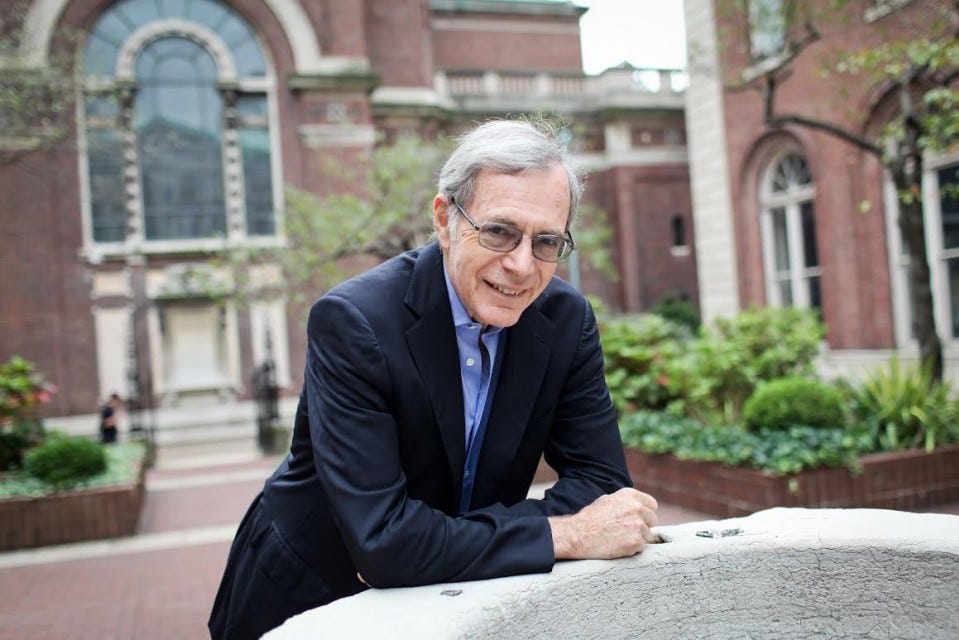
Eric Foner, DeWitt Clinton Professor Emeritus of History at Columbia University, is one of this country’s most prominent historians. He received his doctoral degree at Columbia under the supervision of Richard Hofstadter. He is one of only two persons to serve as president of the three major professional organizations: the Organization of American Historians, American Historical Association, and Society of American Historians, and one of a handful to have won the Bancroft and Pulitzer Prizes in the same year.
Professor Foner’s publications have concentrated on the intersections of intellectual, political and social history, and the history of American race relations. His best-known books are Free Soil, Free Labor, Free Men: The Ideology of the Republican Party Before the Civil War (1970; reissued with new preface 1995) Tom Paine and Revolutionary America (1976); Nothing But Freedom: Emancipation and Its Legacy (1983); Reconstruction: America’s Unfinished Revolution, 1863–1877 (1988) (winner, among other awards, of the Bancroft Prize, Parkman Prize, and Los Angeles Times Book Award; The Reader’s Companion to American History (with John A. Garraty, 1991); The Story of American Freedom (1998); Who Owns History? Rethinking the Past in a Changing World (2002); his survey textbook of American history, Give Me Liberty! An American History (2004); The Fiery Trial: Abraham Lincoln and American Slavery (2010) (winner, among other awards, of the Bancroft Prize, Pulitzer Prize for History, and The Lincoln Prize); and Gateway to Freedom: The Hidden History of the Underground Railroad (2015) (winner of the American History Book Prize by the New-York Historical Society. His latest book is The Second Founding: How the Civil War and Reconstruction Remade the Constitution (2019). Most recently, Norton published Our Fragile Freedoms: Essays.
For more on Eric Foner’s work, see https://history.columbia.edu/person/foner-eric/
Interview with Eric Foner
1) How did the activism of the 1960s shape your understanding of how to approach the study of political history?
I’m a good person to ask that question because I was first an undergraduate and then a graduate student, basically for the whole 1960s. I was in England where I had a two-year fellowship to study at Oxford. I was visiting England and encountering historians over there who were really revolutionizing the study of political history—Eric Hobsbawm, for example, whom I came to know while I was studying on a fellowship in London. Christopher Hill, the historian of the English Civil War.
They were looking for a way of integrating political history and social history, rather than taking just one or the other as the basic subject for inquiry. This was directly connected to what was happening in the streets, both in Europe and the United States, especially in 1968, where thousands of people were involved in labor disputes in France. An idea gained currency: the old-fashioned history, the history that did not go beyond the venues of formal politics, meetings of Congress and French National Assembly, and the meetings of the British Parliament was inadequate in understanding the origins of the crises that were facing American and European politics. The idea that spread rapidly was that what we really needed was a “history from the bottom up.” Instead of concentrating on treaties and legislative events—very specific formal examples of the exercise of political power, now the subject matter was everybody and everything—and every kind of politics.
Now of course this was to some extent, catalyzed by the rise of the second-wave feminism of the 1960s. Women historians who came to the fore at that time made it very clear that from their point of view politics, with a capital “P,” involved a lot more than formal political action. It involved demonstrations and other kinds of radical action. All this can be traced back, I believe, to the mid-1960s, when the anti-Vietnam war events were affecting historical thinking in all sorts of complicated ways.
A vision of the United States United States as the exemplar of democracy for the world was shattered in the mid-1960s by the Vietnam War and by the resistance to the war and President Johnson.
2) Which one or two books have been the most important intellectual influences on your work?
The books that influenced me may not be exactly the ones that influenced other historians, but thinking back on influential books, one was a book of essays called Toward a New Past, which showed how ordinary people had a role to play in the writing of the history of ordinary Americans. Jessie Lemisch’s work on merchant seamen also showed how history could be written from the bottom up.
The book that influenced me the most, and I hate to put myself in the same category as him, was Eric Hobsbawm’s works on the nineteenth and twentieth century, especially the famous, influential essay “From Social History to the History of Society.” You have to take political history, he said, and turn it into a full-fledged analysis of the study of society. Hobsbawm had a great influence for a time in the United States and certainly had a lot of influence on me.
I was thrilled when somebody pointed out that there was a footnote in Hobsbawm’s book on the nineteenth century referring to my doctoral dissertation/book, Free Soil, Free Labor, Free Men. He was a pretty good researcher. There weren’t many copies in England at that time! Nonetheless, it helped to open up the subject matter of history, the cast of characters, and the people at the bottom of society who were reshaping the past and the present.
The activism of the moment in the 1960s as your first question implied really changed how historians thought about their own profession and their own vocation. For more and more people the project of history was developing the material that could enable a critique of American society, a usable past as Howard Zinn called it, a critique of what we know now were the dishonest statements by the Johnson administration about the imaginary gains that were being made in the Vietnam War by American troops. And the sort of history as expose was becoming more and more important in the later part of the 1960s.
Another book that had made a tremendous impact on me was Eugene Genovese’s The Political Economy of Slavery, published in the mid-1960s. It was a new interpretation of the coming of the Civil War. It introduced the concept of ideology back into American history. Scholars of the 1950s and first half of the 1960s didn’t like to write about ideology. Ideology is hard, its brittle, it has some people think, its’ biased one way or another. Genovese published his book at the same time as Bernard Bailyn’s The Ideological Origins of the American Revolution, so suddenly we had ideology back on the table. That inspired me to say, what about the ideology of the North? The ideology of the South, a pro-slavery ideology was not hard to understand, but the ideology of secessionist radicalism was hard to figure out. And Genovese went a long way to doing that.
I decided I was going to write the companion book to that, the political economy of anti-slavery, I was going to write about the people who used politics to change society. That is another way the times affected my writing of history. I was very interested in how politics was a venue through which political change could take place. That was happening on the streets at that moment.
3) In 1976, you published a book about Thomas Paine. How did you decide he would be the focus of your early work?
